

 Custom Aquarium Cost in Dubai
 Saltwater vs Freshwater Aquarium
 Swimming Pool Glass Panels in Dubai
 Koi Pond Maintenance in Dubai
 Adidas Liquid Billboard Dubai
 Green Wall Installation in Dubai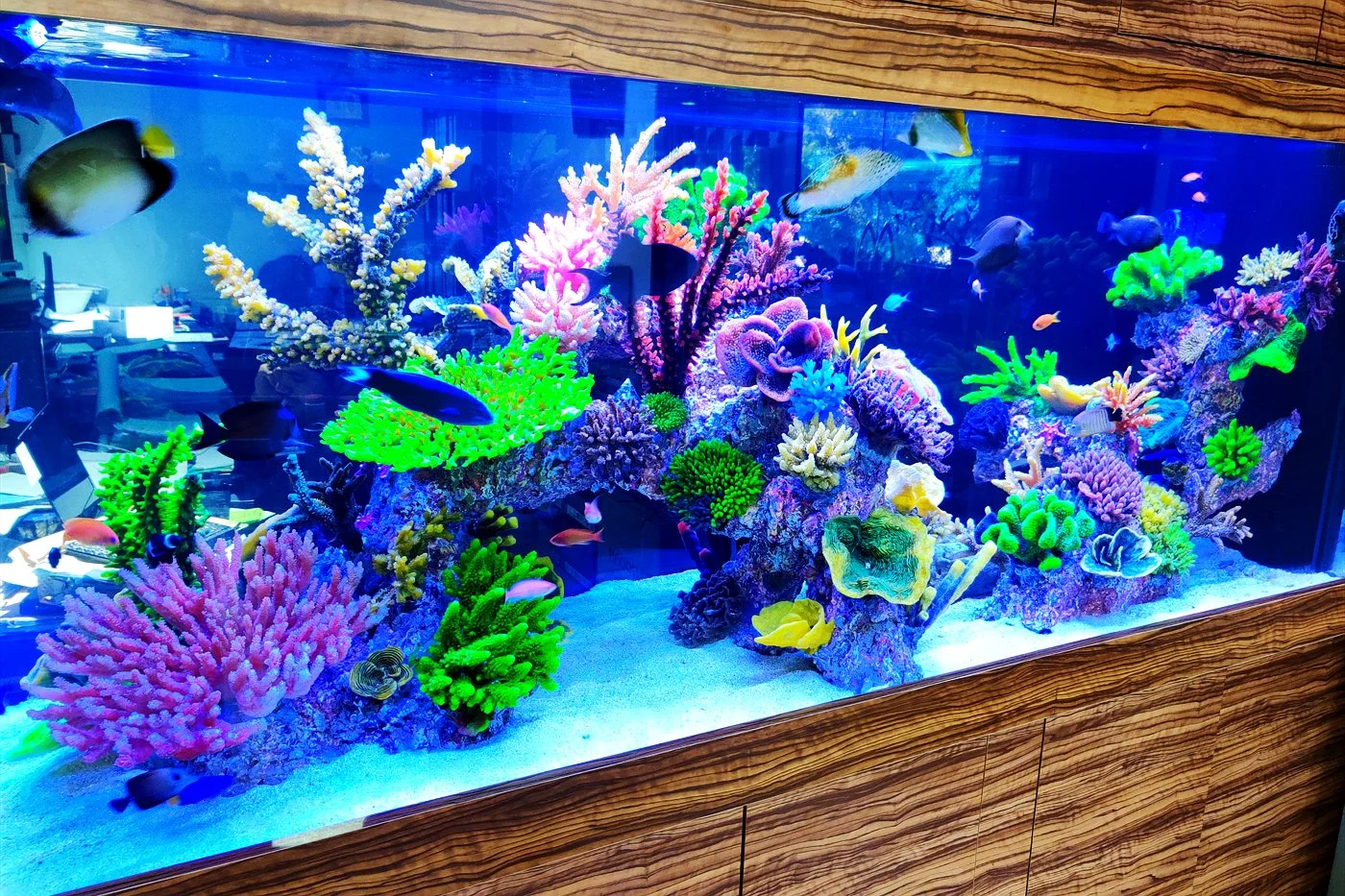
In this article
Lighting decides how an aquarium looks, and in a reef or planted tank it also decides whether corals and plants thrive. Modern LED fixtures can do almost anything, which makes choosing and setting them up more important, not less. This guide explains the basics of spectrum and intensity, what reef, planted and display tanks each need, and how to run lighting sensibly in a UAE home or office.
The three things that matter
Spectrum: the colour of the light
Light is a mix of wavelengths. Corals rely mainly on blue and violet light, which is why reef tanks look blue. Plants use red and blue light, so planted aquariums need a fuller, warmer spectrum. Display-only tanks with fish and rock are set to whatever makes the colours look natural to the eye.
Intensity: how much light reaches the bottom
For reef and planted systems, intensity is usually measured as PAR (photosynthetically active radiation). A PAR meter shows how much usable light reaches each part of the tank. Light drops off quickly with depth, so a fixture that looks bright at the surface may be too weak at the sand bed of a deep tank.
Photoperiod: how long the lights are on
Most aquariums run a lighting period of around eight to ten hours a day, with a gradual sunrise and sunset. Longer is not better: extra hours mostly feed algae.
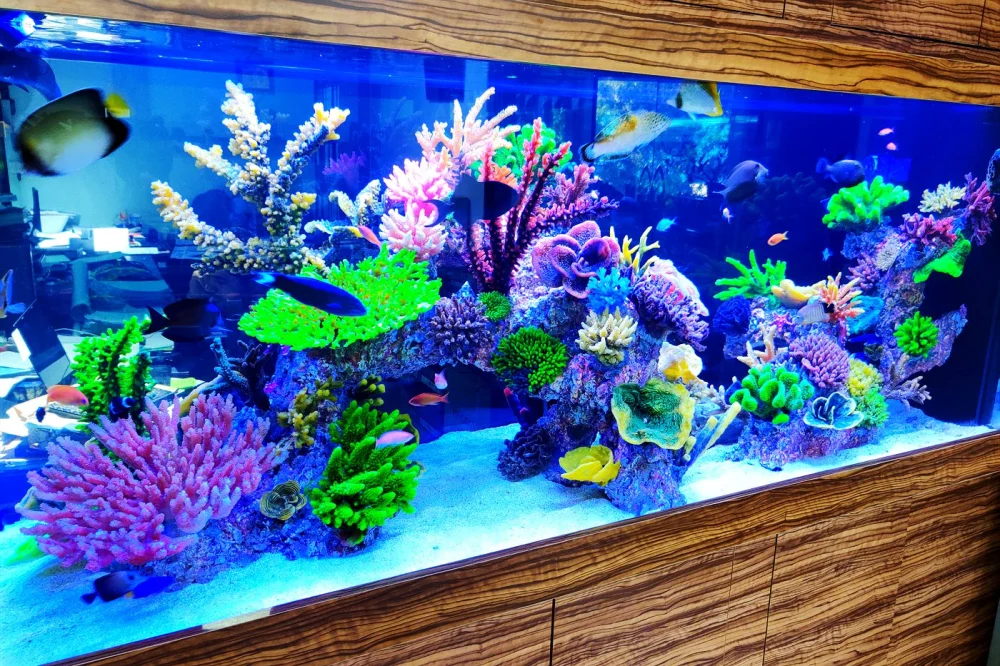
What each type of aquarium needs
| Tank type | Spectrum | Intensity | Main risk |
|---|---|---|---|
| Reef (SPS, LPS, soft corals) | Blue-dominant, with violet | Medium to high, mapped by PAR | Bleaching after sudden changes |
| Planted freshwater | Full spectrum, red and blue | Low to high, matched to CO2 and nutrients | Algae if light outruns nutrients |
| Fish-only display | Natural white or neutral | Low to medium | Over-lighting that grows algae |
Reef tanks: build up slowly
Corals adapt to the light they live under. A new fixture, or a jump in intensity, can stress or bleach them even if the new level is ideal in the long run. Good practice is to start lower and increase over several weeks while watching coral colour and polyp extension. Our reef aquarium setup guide explains how lighting fits into the wider system.
Light-hungry corals belong near the top of the rockwork, and lower-light species further down. Mapping PAR across the tank before stocking avoids guesswork.
Planted tanks: keep light, CO2 and nutrients in balance
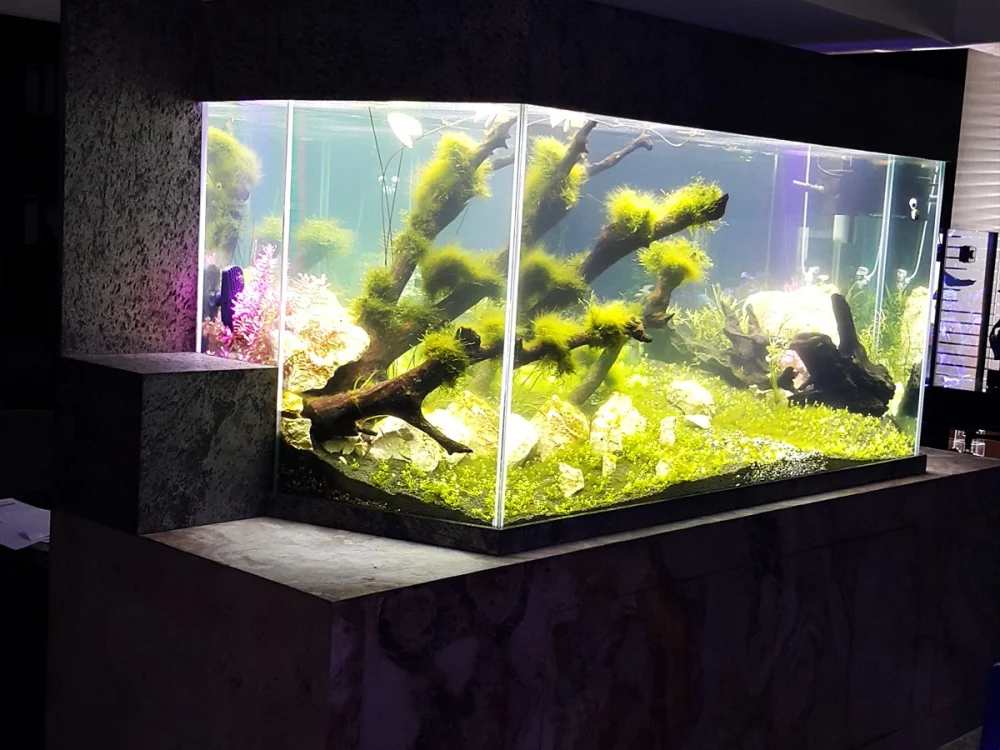
In a planted aquarium, light drives growth only if the plants also have carbon dioxide and nutrients. Too much light without the rest is the most common cause of algae. Beginners do well with moderate light and easy plants; high-light, high-tech layouts need CO2 injection and regular fertilising. See our aquascaping guide for layout ideas.
Practical tips for the UAE
- Sunlight. Strong daylight through a window can drive algae and overheat the water. Position the tank away from direct sun or control it with blinds.
- Heat from fixtures. LEDs run cooler than older lighting, but they still add heat. With summer temperatures, lighting is one of the loads a chiller has to handle.
- Timing. Set the main lighting period for when people actually see the tank, for example evenings in a villa or office hours in a reception.
- Controllers. Most modern fixtures have apps or controllers for ramping, moonlight and seasonal changes. Record the settings so they can be restored after a reset.
- Maintenance. Clean salt creep and dust from the fixture and cover glass. Dirty lenses can cut output noticeably.
Signs your lighting is wrong
- Persistent algae on glass and rock: often too many hours or too much intensity.
- Corals turning pale or brown: sudden changes, or light that is too strong or too weak.
- Plants growing long and thin: not enough light at the bottom.
- Fish hiding all day: the tank may be too bright without shaded areas.
FAQ
How many hours a day should aquarium lights be on?
Around eight to ten hours suits most aquariums, with a gradual ramp up and down. Adding more hours usually increases algae rather than growth.
Do I need a PAR meter?
For reef and high-light planted tanks it is very useful, because it shows how much light reaches each level. For a fish-only display, it is not necessary.
Can I change my reef light to a stronger one?
Yes, but acclimatise the corals by starting at lower intensity and increasing over a few weeks. Sudden jumps can bleach corals.
Why does my tank grow algae after a lighting upgrade?
The new light is probably stronger or longer than the system’s nutrients and livestock can use. Reduce the photoperiod or intensity, then adjust gradually.
For new systems, see custom aquarium design and installation. For existing tanks, our maintenance team can review your lighting, or you can request a quotation.
Further reading: Photosynthetically active radiation (Wikipedia)