


 Custom Aquarium Cost in Dubai
 Saltwater vs Freshwater Aquarium
 Swimming Pool Glass Panels in Dubai
 Koi Pond Maintenance in Dubai
 Adidas Liquid Billboard Dubai
 Green Wall Installation in Dubai
In this article
- Why aquaponics suits schools and CSR programmes
- How the system works
- What students can learn
- Choosing the right size and location
- Planning for the UAE climate
- Holidays and weekends
- Safety and hygiene
- A simple planning checklist
- Frequently asked questions
- Plan a school or CSR aquaponics project
- Aquaponics Classes and Workshops: What to Look For
- Sample Session Plan for a Term
- Questions to Ask Before You Book
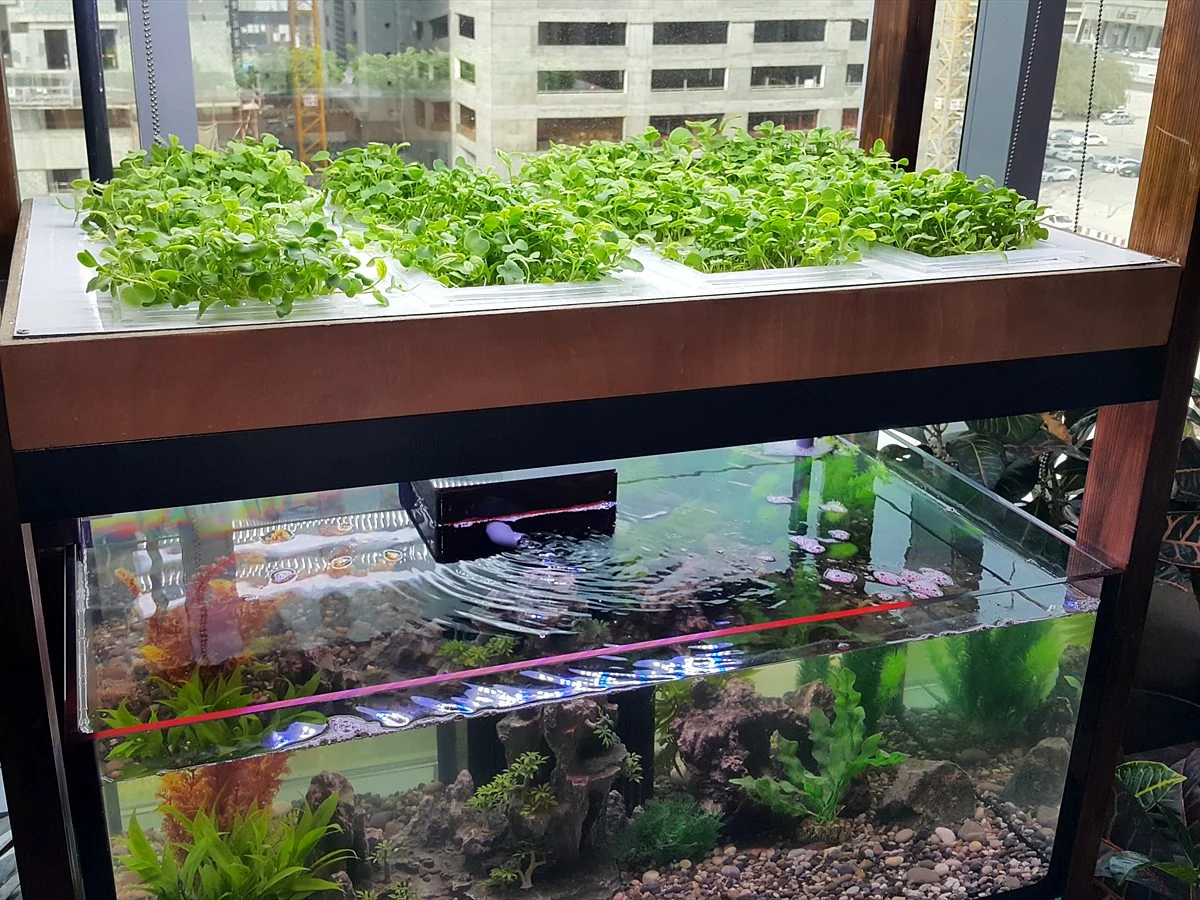
Aquaponics gives students a working ecosystem they can see, measure and care for: fish in a tank, plants in grow beds, and water that moves between them. For schools and companies running CSR programmes in the UAE, it turns sustainability from a topic in a textbook into something people can touch. This guide explains what a school aquaponics project involves and what to plan before you start.
Why aquaponics suits schools and CSR programmes
- Hands-on STEM learning: students meet biology, chemistry and maths in one system, from the nitrogen cycle to plant growth rates.
- Food and sustainability: it shows how fish and plants can produce food with far less water than conventional soil growing, a theme that fits national food security goals.
- Regular routines: feeding, testing and harvesting give students ownership and a reason to return each week.
- A visible CSR story: a living display in a lobby or courtyard shows a company’s sustainability commitment to staff, visitors and the community.
How the system works
Fish produce waste, and bacteria turn it into nutrients that plants absorb. The plants clean the water, which returns to the fish. Our guide to how aquaponics systems work in the UAE explains the loop in more detail, and aquaponics vs hydroponics compares it with growing without fish.
What students can learn
- The nitrogen cycle and why water testing matters.
- Plant biology, including light, nutrients and growth.
- Data collection: logging temperature, pH and harvests, then charting the results.
- Systems thinking, seeing how fish, bacteria and plants depend on each other.
- Responsibility, through animal care and a feeding rota.
Choosing the right size and location
The right setup depends on how the school or company will use it.
- Classroom or lab unit: a compact system on a bench or trolley suits demonstrations and small groups.
- Courtyard or greenhouse system: a larger system grows more produce and works for whole-school or community projects.
- Corporate display: a design-led system in a lobby or atrium combines education with a feature people want to look at.
Whichever you choose, check floor loading, access to power and water, drainage, and whether the system sits in direct sun.
Planning for the UAE climate
- Heat: outdoor water can warm quickly in summer. Shade, insulation and, where needed, cooling help keep fish healthy.
- Evaporation: water loss is high, so top-ups should be part of the routine.
- Power: pumps and aeration need reliable power. Plan how the system is protected during outages.
- Plant choice: leafy greens and herbs are the usual starting point. Some do better in the cooler months.
Holidays and weekends
Schools close for long summer and winter breaks, and fish still need care. Plan this before installation: decide who checks the system, whether automatic feeders are suitable, and how the handover works when staff change. A short written routine saves problems later.
Safety and hygiene
- Wash hands after handling the system, water or plants.
- Keep electrical equipment out of reach and protected from splashes.
- Agree rules on eating produce. Follow the school’s food-safety policy and any local requirements.
- Do not add chemicals or pesticides to the system, as they can harm the fish.
A simple planning checklist
- Define the goal: learning, produce, a display, or a mix.
- Choose the location and check power, water, drainage and floor loading.
- Decide the size and who will look after it day to day.
- Plan holiday cover and a maintenance routine.
- Agree a budget for equipment, set-up, fish and ongoing running costs.
Frequently asked questions
Which age groups is it suitable for?
It can work from primary school through to university, with the depth of the activities adapted to the age group.
Can a school run it without specialist staff?
Yes, with a clear routine, simple test kits and training at handover. An ongoing maintenance service can help where staff time is limited.
Is it a one-off installation or an ongoing project?
It works best as an ongoing project. Feeding, testing and harvesting give the system a place in the school year.
Plan a school or CSR aquaponics project
We design aquaponics and hydroponics systems for homes, schools and businesses across the UAE. See our aquaponics and hydroponics systems, or tell us about your project and we will help you choose the right size and setup.
Aquaponics Classes and Workshops: What to Look For
People searching for aquaponics classes usually want one of three things: a one-off workshop, a recurring after-school club, or a corporate team session. Before you book or request a programme, it helps to know which format fits your group.
- One-off workshop: A session of one to two hours that introduces the fish, bacteria and plant loop with a live demonstration. It suits school assemblies, open days and company volunteering events.
- Multi-week course or club: Weekly sessions let students set up a system, cycle it, add fish, plant seedlings and record results over a term.
- Teacher or staff training: A practical handover session covering water testing, feeding, troubleshooting and holiday cover, so your own team can run the system confidently.
- Family or community day: Short, hands-on stations for mixed ages, such as testing water, planting seedlings and learning about the fish.
When comparing providers, ask whether sessions are hands-on or only presentations, whether materials are included, and whether the class works with a real system on your site or a demonstration kit.
Sample Session Plan for a Term
A structured term helps students see the whole cycle. This is an example outline that can be adapted to age group and time available.
- Week 1: Meet the system. Identify the parts: tank, pump, grow bed and plumbing. Discuss why fish and plants help each other.
- Week 2: The nitrogen cycle. Test water and record ammonia, nitrite, nitrate and pH. Discuss what the readings mean.
- Week 3: Planting. Sow seeds or transplant seedlings and set up a growth log.
- Weeks 4 to 7: Care and data. Rotate feeding and testing roles, chart changes and compare plant growth.
- Week 8: Harvest and review. Harvest what is ready, follow your food-safety rules, and present findings to another class or colleagues.
Questions to Ask Before You Book
- What group size and age range can the session handle?
- Is the activity linked to curriculum topics such as ecosystems, chemistry or sustainability?
- Who supplies equipment, test kits and any live fish, and who looks after them afterwards?
- Can the session be run on your premises, and what space, power and water access does it need?
- Is there a follow-up option, such as a refresher visit or a maintenance routine, so the project continues after the first session?
For CSR programmes, also consider how you will share the outcome: a short student presentation, a photo log of the harvest, or a simple report of what the group learned can turn one session into a lasting story.