
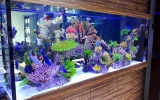
 Custom Aquarium Cost in Dubai
 Saltwater vs Freshwater Aquarium
 Swimming Pool Glass Panels in Dubai
 Koi Pond Maintenance in Dubai
 Adidas Liquid Billboard Dubai
 Green Wall Installation in Dubai
In this article
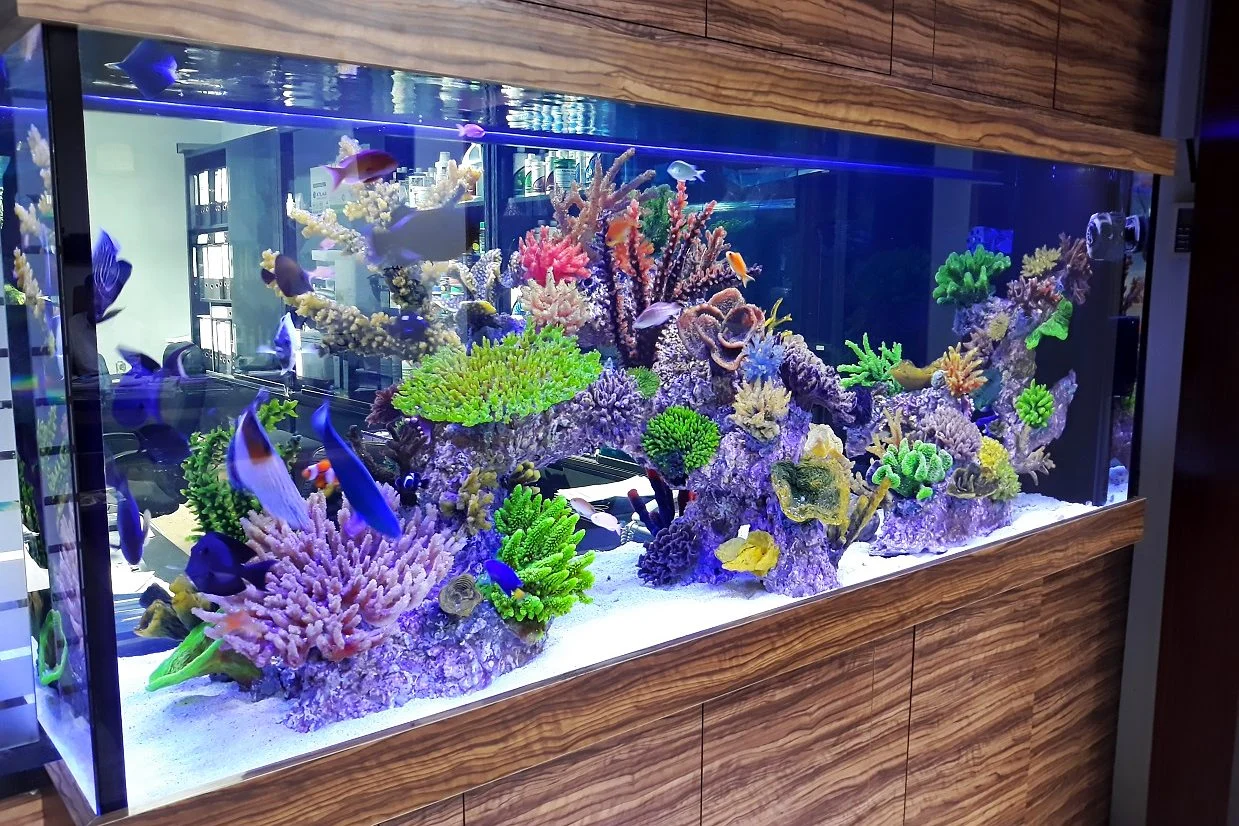
The background of an aquarium is the largest surface in the view, yet it is often the last thing planned. A custom 3D background or built-in rockwork turns a plain back wall into a reef face, a river bank or a rocky cliff, and hides pipes and equipment at the same time. This guide covers the main types, the materials that are safe for fish and corals, and how to plan one into a new aquarium.
Types of aquarium backgrounds
| Type | What it is | Best for |
|---|---|---|
| Painted or film | Colour or image on the outside of the back panel | Simple displays and tight budgets |
| Ready-made 3D panel | Moulded panel fixed inside the tank | Standard sizes and freshwater tanks |
| Custom 3D background | Sculpted and textured to the exact tank | Custom aquariums, feature walls |
| Built-in rockwork | Rock structures integrated with the tank design | Reef tanks, large displays, public spaces |
Why go custom?
- A finished look. The background becomes part of the scene rather than a wall behind it.
- Hidden equipment. Overflows, return pipes, heaters and sensors can sit behind or inside the background.
- Depth. Layered rock and caves make a tank look deeper than it is.
- Habitat. Caves, ledges and overhangs give fish shelter and territories.
Materials that are safe for livestock
Anything inside an aquarium must be inert once cured: it must not leach chemicals, change the water chemistry or break down. Custom backgrounds are usually built on a lightweight core and finished with aquarium-safe coatings, resins or cementitious mixes, then fully cured and soaked before livestock goes in. Paints and fillers that are not designed for permanent immersion are avoided.
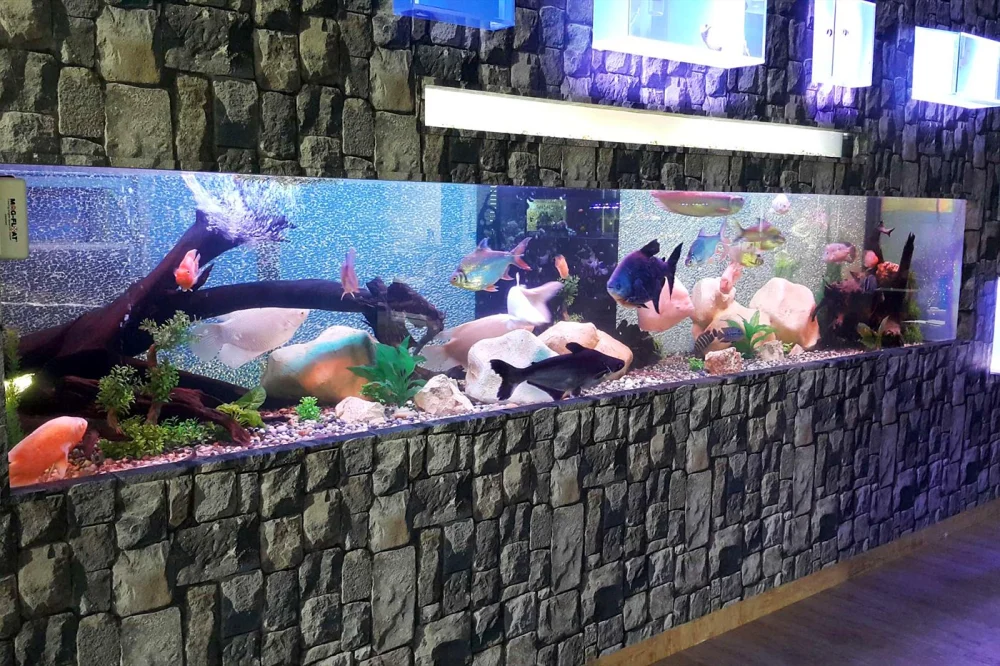
- Freshwater: river-bank, slate and root-like textures; plants can be attached to the surface.
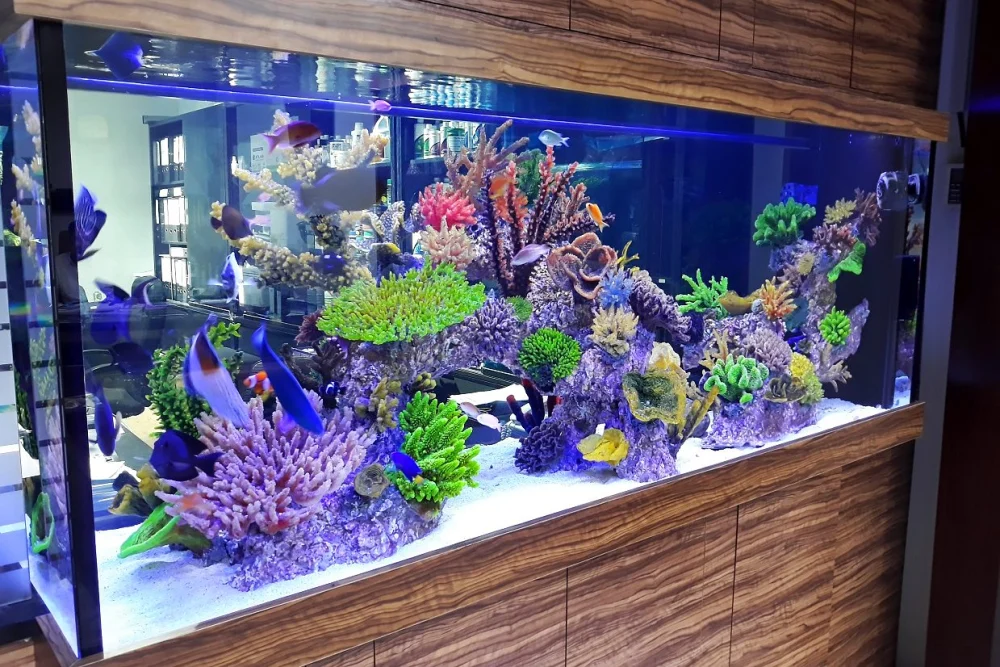
- Marine and reef: rock-like surfaces with plenty of open structure and flow paths; corals can be placed on ledges.
Design points to settle early
- Thickness. A background takes space from the front-to-back depth. In a slim tank, keep it shallow.
- Flow. Water must move behind and around the structure. Dead spots trap waste and cause water problems.
- Access. Equipment behind the background needs a way to be reached or replaced.
- Weight. Large rock structures add load; lightweight cores keep it manageable.
- Cleaning. Textured surfaces collect algae. Choose shapes that can be cleaned or that hide growth naturally.
- Lighting. Shadows from overhangs change how the scene looks; plan lighting with the background.
Planning it into a new aquarium
A custom background is easiest and best when it is designed with the tank. It is fitted before the aquarium is filled, often at the same stage as the overflow and plumbing. Adding one to an existing tank means draining and rehousing the livestock, so it is usually done during a rebuild or a relocation.
The background is one part of the overall look. For layout ideas, see our aquascaping guide and wall aquarium ideas.
FAQ
Are 3D aquarium backgrounds safe for fish?
Yes, when they are made with aquarium-safe materials and fully cured before the tank is filled.
Can a background be added to an existing aquarium?
It is possible, but the tank must be emptied and the livestock housed elsewhere, so it is best done during a rebuild or move.
Do backgrounds make cleaning harder?
Textured surfaces grow some algae. Good design and the right clean-up crew keep it under control.
How much does a custom aquarium cost?
Our freshwater aquariums start from AED 15,000 and saltwater from AED 20,000. A custom background is priced as part of the design.
For the service overview, see custom aquarium design and installation, or customise your aquarium with us.
Further reading: Aquascaping (Wikipedia)
Choosing Between a Panel and a Custom Build
The right option depends on tank size, livestock and how long you plan to keep the setup. A few questions help narrow it down.
- Is the tank a standard size? Ready-made panels are cut for common dimensions. Unusual sizes, corner tanks and tanks with built-in overflows usually need a made-to-measure solution.
- Freshwater or marine? Reef tanks need open structure and flow paths, which a flat moulded panel rarely provides. Freshwater tanks with a river-bank look suit panels better.
- Is the tank a feature piece? In a living room wall, restaurant or office, the background is seen all day, so a sculpted finish that matches the interior is often worth the extra planning.
- Will equipment be hidden? If pipes, heaters or a sump return need concealing, a custom build can include channels and service openings from the start.
As a rule of thumb, panels suit simple setups, while custom work suits tanks where the background and equipment layout must be designed together.
Preparing a New Background Before Adding Fish
Even an aquarium-safe background needs preparation before livestock goes in. Skipping these steps is a common cause of cloudy water and unstable readings in the first weeks.
- Confirm the cure. Resins and cement-based finishes must be fully cured. Follow the maker’s guidance rather than guessing.
- Rinse and soak. Soak or flush the structure with clean water to remove dust and loose particles. Change the water until it stays clear.
- Test the water. Check pH, hardness and salinity (for marine tanks) over several days. A steady reading suggests the material is not altering the water.
- Cycle the tank. Let the biological filter establish with the background in place before adding fish or corals.
- Add livestock gradually. Watch behaviour and water readings as the first inhabitants settle in.
Maintaining a 3D Background Over Time
A well-built background needs little work, but routine care keeps it looking good.
- Algae control. A light film of algae is normal and can look natural. Use a soft brush or a gentle flow of water on heavy areas, and keep lighting hours and feeding steady.
- Avoid harsh tools. Metal scrapers and abrasive pads can damage coatings. Choose soft brushes and tools suited to the surface.
- Keep water moving. Check that detritus is not collecting in caves and behind ledges. Adjust pumps or powerheads if you see dead spots.
- Inspect access points. Make sure service panels and openings stay clear, so equipment can be reached without disturbing the scene.
- Watch for changes. Peeling, cracking or discolouration is worth investigating early, before it affects the water.
Done regularly, these small checks help the background stay stable and attractive for years.
If you are planning a feature wall that doubles as a focal point in a home or lobby, a custom gate aquarium shows how a tank can be built into an architectural opening.